Showing posts with label Teaching. Show all posts

Saturday, 10 March 2018

Education - Multicultural & International Perspectives, engagement & agency.

Week 14 - Multicultural and International Perspectives, engagement & agency

PISA

This week started by viewing this video about PISA. Programme for International Student Assessment (PISA) testing is used to measure international success of students from the Organisation for Economic Cooperation and Development (OECD). The OECD is a combination of 34 countries who come together to come up with better policies to improve people's lives. In the 1990’s they looked at how prepared 15 year olds were for their futures as most have finished compulsory formal education by then. They came up with a 2 hour test for core subjects like reading math and science. Participating countries ran this test every 3 years, rotating the 3 subjects each year.

PISA tests if students can use what they have learnt in school and apply these to real life situations and problems. PISA takes the results of all students and analyses this data to compare how countries have ranked. Similarities and differences are shown so governments can analyse results and change education policies if needed. PISA looks at how successful all students are and looks for the characterics of the more successful countries and trends and patterns. Such as girls often outperform boys in reading, and in math boys tend to outperform girls. Another finding is that deciding student pathways early on does not necessarily impact the performance of the student. Also all children have the potential to succeed if given the opportunity and are supported despite their home background also having a major impact on student success.

Engagement

Prior to class I also read an article from Australian Institute for Teaching and School Leadership. (2016). ‘Engagement in Australian Schools’. This discussed the ambiguity of ‘engagement’ which is hard to define. Often policy makers have been focused on ‘disengaged’ behaviour rather than promoting engagement. Some ideas from Fredericks et. al. (2003) suggests it involves three types of engagement:

Cognitive - which is hard to measure, involves students investment in their own learning. Cognitively engaged learners are focused, resilient, flexible, and goal orientated. We can use physical signs to measure this such as facial expressions, reaction times, question asking/answering etc.

Behavioural - involves behaviour that enhances high performance such as collaboration and communication with others, and participation in other areas of their lives. Essentially are the learners ready to learn and this will help with being cognitively involved. Physical signs may be easier to measure such as attendance, reading and writing achievement data, social withdrawal, negative interactions etc.

Emotional - how the learner is feeling in relation to other learners, teachers, family and friends do they feel emotionally bonded with others. Can measure by asking students about their attitudes and beliefs etc.

We can improve engagement by having flexible, individualised teaching, in a supportive learning environment, like project based learning. Also by strong student-teacher relationships and regular monitoring, trying to make learning feel more relevant to the student, providing choice in future pathways and developing an environment where it is OK to make mistakes.

We then moved on to the ‘don’t ask me where I’m from video’. This was about how to define culture. Nationality is quite different to culture. Essentially your culture is about where are you might be a local. This includes rituals, relationships, and restrictions (where you are able to live, work, travel etc).

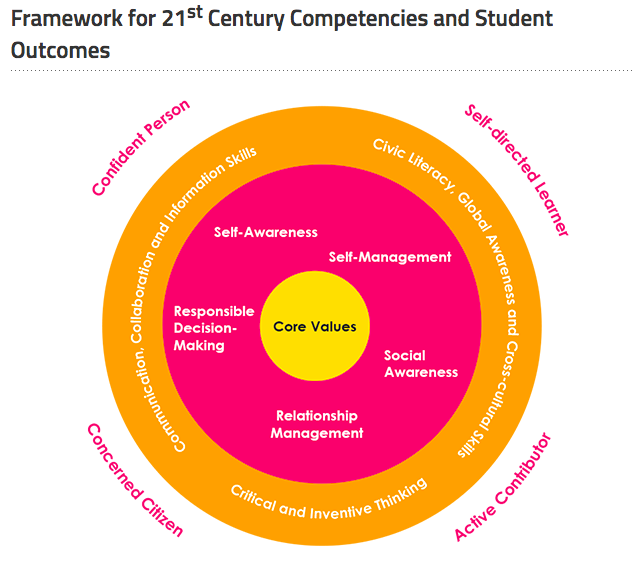
The World Economic Forum (2016) lists 16 skills for 21st century learning and they have included cultural & civic literacy and social and cultural awareness etc.


I think this is a great way to describe a holistic approach to curriculum development as it takes into account relevant competencies and personal character, not too sure about how the foundation literacies have been split up but good to see cultural and social awareness were explicitly included.

It was also interesting to learn which three NZ curriculum principles were the least well represented in classrooms based on research by ERO in a review done in 20012. Cultural diversity, future focus and treaty of waitangi were least well represented. I guess for most schools we are all trying to improve in these areas and probably could do with more help and professional learning in these areas.

We then dived into having a look at curriculum in other countries, and having spent a bit of time in Singapore back in the day I suggested we could have a quick look into this curriculum. We found some interesting information. Singapore includes civic literacy, global awareness and cross-cultural skills and social awareness as part of their 21st century competencies;


We were also wondering how well students from Singapore were rated in PISA and found that they were ranked top in math, science and reading in 2015 and also ranked highest in collaborative skills. They also seem to have a small number of bottom performers and a high number of top performers so the education system appears to be very successful for all students.

Agency

We then moved on to looking at learner agency which can be defined as the capability to make choices and act on these choices in a way that makes a difference to the learners life.

We watched a video from Tim Gander about learner agency. He was a teacher who inquired about how he could give his students more choice and how best to help develop their own agency. He developed and co-constructed what this would be for individuals. He create agency with the learners, and looked into how they could take action and deal with barriers, credits, timetables time pressures etc. Many of this they could not change but they did implement 20% time for self directed learning which they shared in an online learning community that also fed into assessments. They created a credits barrier hack by rewriting all the internal assessments to make them more authentic for the class. They developed a flow chart about what they were interested and boys could choose their own path and what they did to enable the choices. Many learners were initially lost and had trouble making the decisions and Tim wondered if by having agency essentially they had chosen to opt out. So they went back to redefine agency to include choices needing to make a difference to yourself and others. There was the ongoing tension of freedom to choose meaning they could choose to engage or not, and having a balance of academic rigour and freedom. This video brought up loads of themes around ways to engage students and how to handle assessments. Some food for thought.

We have just introduced some independent learning time at our school and have been looking at ways to support students to set realistic goals and actions. Many teachers have found some simple ways to engage students in meaningful learning and I look forward to seeing how this evolves over time.

References

Australian Institute for Teaching and School Leadership. (2016). Engagement in Australian schools. Retrieved from http://www.acleadersresource.sa.edu.au/features/engagement-in-learning/workshop-1/Handout_4_Engagement_in_Australian_Schools.pdf

Fredericks, J. A., Blumenfeld, P. C. & Paris, A. H. (2004). School Engagement: Potential of the Concept, State of the Evidence. Review of Educational Research, 74(1), 59-109.

World Economic Forum. (2016). New Vision for Education: Fostering Social and Emotional Learning through Technology. Retrieved from http://www3.weforum.org/docs/WEF_New_Vision_for_Education.pdf

Saturday, 3 March 2018

Education - Games and Educational Game Design


Week 13 - Games and Educational Game Design

Prior to class we were asked to play a game for 10 mins and think about what makes us play and keep playing the game? So as I was reading this instruction at home I was sitting at our kitchen table with our two children Mr 7 and Miss 8 who were playing Roblox. They are now only allowed play for limited times on the weekend as they were getting so addicted and turning into rude zombies during the week. So I asked them why do they play and what makes them keep playing?

Mr 7 said “I play because it’s fun and entertaining, and I keep playing because it it gets more fun and I save up for something like more than 3000 so I can buy my 2nd floor of my noob invasion house.”

Miss 8 said “I like listening to all the music, and I like saving up for stuff I even make lists of all the stuff I want to save up for. I love being pretend characters too”

I have on occasion played things like Tetris back in the day or the Farmville game on Facebook and I guess for me it has been a way of escaping, switching off or procrastinating from doing other things and there was always something just out of reach that I could achieve if I just kept playing. So I guess in terms of learning it is bit like how we scaffold learning or work on things just out of our reach or our comfort zone and then when we get there we a satisfied for a moment then start working on learning the next thing. It also reminds me of my martial arts training, there is always another belt grade to look forward to or something to improve or new to learn, there are others just ahead of us showing us the way which keeps us motivated and inspired. There is something addictive about ‘levelling up’. But are we ‘addicted’ to healthy habits/games or unhealthy habits/games or both at times? Despite doing a fair bit of exercise during the week I do enjoy indulging in food too.

We were also asked to watch the Seth Priebatsch's 4 game mechanics video. He talks about 4 game dynamics that can be used to influence behaviour. He describes a game layer on top of the world that has started to develop but it is just kind of boring and sux. He talks about examples such as loyalty cards etc. He says we can design better games and it has started in the last decade with the social layer of connections with Facebook etc. The next decade is the game layer which we will develop further which is all about influencing behaviour, including what, where and how you do things. The tools to build this layer are game dynamics which we have to be purposeful about using. He talks about 4 important ones:

  • Appointment dynamic - Players do something at a particular place and time. In real life this is like the ‘happy hour’ idea. An extremely popular game example is Farmville, you have to water your plants within a timeframe or they die. Another example is an app that helps people take their medication on time.
  • Influence and status dynamic - Players want to work hard to achieve something like a badge/status etc. For example in games you play to move up levels like school.
  • Progressions dynamic - Gradual success displayed through completion of tasks. For example % complete displays for setting up profiles on Linkedin. We want to finish things when reminded such as progress bars.
  • Communal discovery - everyone works together to achieve something. On Digg.com people find and source the best stories and you get points, people worked together to remain on top of the leaderboard. This made me think of countdowns cards, where together people swapped cards etc to get complete sets.
So the challenge is how can we build in some game dynamics to keep people motivated and influence desired behaviours when learning and leading?

We further explored these ideas by playing as a whole class group. The game was called Cat on Yer Head, it starts with everyone standing around but within touching distance of others, then one person starts as the cat who repeats ‘cat, cat, etc’ until they touch another person who becomes the cat. At the same time someone starts as the mouse and repeats ‘mouse, mouse, etc’ until they touch someone and they become the mouse. The objective is for the cat to catch the mouse, so if you get tagged by a cat or a mouse you are switching roles to help the mouse escape or get the cat to catch the mouse. It was crazy trying to switch and keep up at times.

We had a few goes then went inside to reflect and try to modify the game to try to enhance the experience. To make it more engaging we decided to use ping pong balls as the mouse or the cat to pass around rather than speaking and the balls were more easily hidden so everyone had to pay more attention in the game. This kept everyone on their toes. Then we decided to add a dog to chase the cat and mouse, this kept it even more interesting.

So we found ways to improve the flow of the game. Flow theory is the essence of games, it is the balance between the skill you have and the difficulty of the game. So it is a moving target and your target changes as your skills develop. You can change the rules of a game to improve the flow experience. I guess as a teacher I have always thought of this as knowing the learner so you can provide collapsing scaffolds and try to find that zone of proximal development (Vygotsky). I just hadn’t really realised how much this flow idea in good game development was related to effective learning experiences.

We also took a look at 4 keys to fun from Nicole Lazzaro which is focused on 4 key emotions as follows:
  • People Fun (friendship)
  • Hard Fun (challenge)
  • Easy Fun (novelty)
  • Serious Fun (meaning)
According to Amory (2007), Educational computer games should:
  • Be relevant, explorative, emotive and engaging
  • Include complex challenges, puzzles or quests
  • Be gender-inclusive and non-confrontational
  • Provide appropriate role models
  • Develop democracy and social capital through dialogue
  • Support authentic learning activities
  • Support the construction of tacit knowledge
We played http://www.kupuhono.co.nz/ and looks at aspects of game design within this game. James Paul Gee also has some interesting ideas about video games, theory of learning and how you can play games instead of teaching and taking tests because while you play the game you are completing the test and learning as you go along so you don’t need at test as such at the end.

Now going back to Mr 7 and Miss 8 maybe they weren't so much turning into rude zombies, they were actually in the flow state of playing the game, but I guess the bigger question is about the impact of particular games on our children and how can we harness this flow state for purposeful learning.

So lots of great themes this week and I guess it boils down to the classic reflection as a teacher about how can we have more fun with our learning as well as what can we do to make sure we are supporting students with challenges that push the students enough to not be bored and on the flip side are not too tricky leaving them to struggle too much as we want to ensure the learners are often in the flow state. So this must involve getting to know your learners and understanding the impact you are having in trying support students in their flow of learning and maybe ultimately helping them to be more aware of how they can take charge of their own learner agency and flow state. Much to ponder after this weeks learning.

References
Amory, A. (2007). Game object model version II: a theoretical framework for educational game development. Educational Technology Research & Development, 55(1), 51–77

Davis, R. (2014). Cat On Yer Head. Playniac Ltd. Retrieved from http://www.catonyerhead.com/

Friday, 2 February 2018

Education - Personal Learning Networks, Connectivism and Leading Change


Week 9 - Personal Learning Networks, Connectivism and Leading Change


This weeks class started with a challenge - we were given 10min to find out where John P Kotter might be right now. We worked in small groups and each of us had some different ideas, some used social networks like Facebook, Linkedin and other digital tools like wikipedia, whitepages, Google Maps or world clocks etc. Together we worked quickly in putting together and cross checking our information. We found out his age, home address, and work location etc. This was a great example of connectivism in action, technology has enabled us to connect and collaborate beyond our physical environment and we are able to draw on a range of perspectives and collaboratively generate and critique new ideas. This is a relatively new view of how technology has changed how, and what we learn.

Prior to class were were asked to read part of ‘A Learning Theory for the Digital Age’ by Siemens, G. (2004). These were some of the key ideas about this theory of connectivism:
  • Many learning theories were developed prior to the digital age such as behaviourism and constructivism. Informal learning is now a big part of our lives. Most older learning theories focus on learning that occurs within a person and don’t address learning that happens outside of themselves like learning that is stored and manipulated by technology.
  • Older learning theories don’t really describe learning that happens within organisations.
  • Older learning theories tend to focus on how we learn not so much what is learnt.
  • Connectivism looks at the complexities of learning as a network and environment that cannot be entirely controlled by an individual. 
  • Connectivism is based on decisions being made on rapiding moving foundations.
  • It is vital to understand the flow of information in an organisation and how it is formed as links between people.
  • Connectivism realises that complete knowledge doesn’t lie in the mind of one person so requires a different approach to leadership.
  • Diverse teams and innovation are key in truely exploring ideas.
I think the view of connectivism is very relevant and evident in the underlying philosophies of our school. We believe that the ability to learn is more important that what you have learnt. That given the uncertain future and impact of digital technologies students will need to be able to work out what they know and what they need to do next to solve problems and interact with their environment and connected networks to learn and create the required knowledge. Connectivism is way to understand the skills and dispositions needed for students to be successful in the 21st century.

At our school this is kind of understanding is very evident in our vision statement and underlying philosophies that were based on some interesting New Zealand research such as this report about future orientated teaching and learning from the OECD. Our school vision is ‘To empower our people to be connected, collaborative, community minded learners inspired to soar’. We acknowledge that learning occurs in all aspects of our lives and that learning happens within the wider the social and emotional contexts and that our interaction and connection with the environment and networks is infact how we learn. This is very much like the view of connectivism in that our ability to learn what is needed for tomorrow is more important than what we know today. I feel connectivism is a great progressive description of how we view learning at our school.

This week we also looked at a Personal Learning Networks video. A PLN consists of the people or organisations that influence our learning. In pairs we discussed each others networks and created an infographic. We used online tools such as Piktochart or Canva. Again it was a reminder about how technology has enabled us to be so well connected personally, nationally, and globally.

We then went on to look at how connectivism has come about as it a fairly recent theory, which makes sense as the developments in technology are really quite recent. It also now makes sense to me that Massive Online Learning Communities (MOOCs) came about as a response to the new ideas of connectivism, and also reminds me of ‘un-conference’ and ‘pechakucha’ type learning sessions I've experienced.

This lead on to looking at a collection of essays that Stephen Downes had put together about connectivism. Some really interesting ideas were presented and in summary we found that connectivism is about creating learning objects on the fly, learning is what we create with others, and we have the tools.

We also looked at influences on leadership and we used an online tool called Coggle to create a collaborative brainstorm/diagram. We briefly looked at the differences between management and leadership, and came to the conclusion that we probably have a good idea about the differences but it’s probably not always so easy to implement. I believe we have all probably had great discussions at some point with people about aspects like I vs we, command vs ask, know vs shows etc.

Kotters’ views for successful change suggests a vision is very important. Getting people involved to collaborate a vision for change and then we need to communicate the vision often. We should remove obstacles and focus energy there and also recognise people’s efforts.

Kotter (1996) describes 8 steps for successfully leading change.
  1. Create a sense of urgency (identify crises and opportunities)
  2. Build a guiding team
  3. Develop a vision and strategy
  4. Communicate the vision
  5. Enable action by removing barriers
  6. Creating and celebrating short term wins
  7. Sustain change by building on gains
  8. Embed the change in culture
The first 3 steps are vital in creating the climate for change, the next 3 involve and enable the organisation to change, the last two are about implementing and sustaining the change. It can be a messy process and by developing the vision it can guide people through and less errors might be made along the way.

People will be intrinsically motivated if they share the vision and have a sense of purpose, and work with peers to solve difficult problems. I will need to keep this in mind when planning and implementing e-learning objectives at our school. There is more information here about Kotters 8 Step Process for change. Also the PPTA have a toolkit for change mangement - PPTA toolkit for change management.

References
Bolstad, R. Gilbert, J. McDowall, S. Bull, A. Boyd, S. & Hipkins, R. (21012). Supporting future-oriented learning and teaching: A New Zealand perspective. New Zealand Council for Educational Research.Retrieved from https://www.educationcounts.govt.nz/publications/schooling/supporting-future-oriented-learning-and-teaching-a-new-zealand-perspective. Accessed 3 Feb. 2018.

Kotter, J. (1996). Leading Change. Boston, Mass.: Harvard Business Review Press.

Siemens, G. (2004). Connectivism: A Learning Theory for the Digital Age. eLearnSpace. Retrieved from http://www.elearnspace.org/Articles/connectivism.htm. Accessed 3 Feb. 2018.

Monday, 22 January 2018

Education - Online and Distributed Leadership & Blended Learning


Week 7 - Online and Distributed Leadership & Blended Learning


The flipped learning for this week was to complete the 7 Step Twitter Challenge to become a more connected educator. The steps for newbies were to create an account, update your profile, follow some other tweeters like @nzMindLab, tweet, reply, find interests and explore. There were also some suggestions for people who already use Twitter such as participate in a Twitter chat event such as #edChatNZ. I am pretty much a novice when it comes to Twitter I basically use it as a place for professional learning and use Facebook for my personal connections with family and friends. So it kind of keeps my professional life a bit separate to my personal life. I use Twitter to read and upskill on tech and teaching ideas and follow some interesting people and organisations.

We were also asked to read an extract from James Spillane’s book ‘Distributed Leadership’ chapter 1 - How does my situation impact my leadership? One quote stood out for me ‘from a distributed perspective, leadership involves mortals as well as heroes. It involves the many and not just the few. It is about leadership practice, not simply roles and positions...leadership practice is about interactions, not just the actions of heroes.' This kind of leadership has been linked to improved engagement in teaching and learning.

We were also invited to complete a task using Edpuzzle.com. Basically a video had been prepared that talked about flipped classrooms and differentiation. The facilitator had added in extra narrative and questions to answer during the video at particular points. We were then asked if we had done this before, I myself have made videos before to use with students in class but not no much expected them to view them before the next lesson. It was a good reminder about using class time to apply and refine knowledge and teachers having more time to then to go around and give individual support as some prior learning has been done prior to the class.

I had completed the homework tasks and was ready to go for class. We started out with some discussion around Flipped vs Blended learning. Blended basically involves some online learning activities and some other traditional learning activities. Flipped is more about a subset of blended learning primarily focused on videos that have been created in advance for students to access. Videos are great for conceptual learning as a base and then in class time can be focused on more creative tasks as Salman from Khan explains in this video.

We discussed a number of tools that could be used for flipped and blended learning such as:
  • TEST Teach with Blendspace
  • TedED
  • EdPuzzle
  • Commonlit
  • PlayPosit
We then moved on to digital discussions and what tools we could use to facilitate discussions such as:
  • Todays Meet
  • Disqus
  • Blogs
  • G+
  • Twitter
We also checked out this video about leadership Distributed Leadership by Professor Alma Harris who discussed many of the pros and cons of distributed leadership which is definitely worth checking out.

We finished by looking at wicked problems and the NMC/CoSN Horizon Report for K12 which looks at the future of education, trends and technologies that will disrupt education and society. We were also asked if education is a wicked problem.

We had some great group discussions about the politics, multiple stakeholders, changing views, society, research, etc. Education is a very complex beast with many stakeholders, views, outcomes and systems in place. There is no silver bullet or ‘right way’ to ‘do’ education that would ensure it is beneficial for all stakeholders. It will probably continue be an awesome challenge for the stakeholders involved for many years to come and much like distributed leadership it is probably more about the interactions between the stakeholders than the actions taken. This has reminded me of one of my favourite whakatauki:

Unuhia te rito o te harakeke kei whea te kōmako e kō

Whakatairangitia rere ki uta rere ki tai

Ui mai koe ki ahau he aha te mea nui o te ao

Māku e kī atu he tangata, he tangata, he tangata!

Remove the heart of the flax bush and where will the kōmako sing?

Proclaim it to the land proclaim it to the sea

Ask me ‘What is the greatest thing in the world?’

I will reply, ‘It is people, people, people!’

So it’s currently the beginning of 2018 and our new school I guess is no longer so new as we are heading into our 3rd year of being open. I’m excited as it’s been a very crazy couple of years with loads of personal challenges and growth involved. I’ve also just realised how awesome and relevant it is that our focus for the first semester is whanaungatanga (relationships). I look forward to reconnecting with the staff and students and meeting the new staff and students. I'm also excited to continue the awesome journey that this AUT Mindlab course is taking me on. Woohoo for the first blog of 2018!!! Ka kite anō.

References

Spillane, J.P. (2006). Distributed Leadership. San Francisco, CA: Jossey-Bass.

Wednesday, 6 December 2017

Education - Digital Disruption & Implementing Technology...

Week 3 Flipped Learning (Homework)


Okay so I’m back for blog post number three - yeehaa! It has been a really fun week, so for homework we started by assembling Google Cardboard headsets. Once you are done you place your phone into the headset and it turns into a low cost virtual reality headset. You can check it out at https://vr.google.com/cardboard/. We were also asked to install the following apps onto our mobile devices - Aurasma, Quiver, Expeditions and Google Translate. If we had an Android device, we also needed to download Anatomy 4D and Elements 4D. I have had a tinker with this cardboard VR before but but had not used many apps so was excited to have another look into the possibilities.


We also read an article ‘Conditions for classroom technology innovations’ and it included some interesting stories about digital innovations that teachers tried to implement and how successfully or not so successfully they were implemented. Basically they came up with 11 key factors grouped into 3 areas which had an impact on the success of the technology innovations. The three key areas included:


  • The innovator (teacher) - their technological knowledge, how the tech fit with the teacher pedagogy, and knowledge of the school's social environment and organisational structure.
  • The innovation (project) - how much of a shift the innovation was from the current school culture, teachers current practice and current resources.
  • The context (school) - which included the technological infrastructure, human infrastructure (support staff, policies and processes etc) and the organisational culture.


I think in the end it was pretty much common sense (although a good friend of mine once said “well common sense is not so common actually”). Basically a strong teacher had the biggest impact on success, small incremental independent steps and quick wins worked well and social support was also needed.  I think that was the gist of the article in the end. So armed with my Google Cardboard I was ready for our classroom session (apart from the magnet button thing not working properly which totally bugged me).


Leadership - Implementing Technology Innovation - In Class Time

We launched straight into looking at two models that help teachers implement technological innovations in the classroom - SAMR and TPACK. Well, I was already familiar with SAMR but had not heard of TPACK before so this was great and I was keen to find out more about this.

SAMR was developed by Ruben Puentedura and includes 4 ways to integrate technology in your learning activities. You can check SAMR out on the TKI website. Mark Anderson has created a version of SAMR that shifts the focus slightly to teachers confidence. These tools help teachers to design learning tasks that significantly transform the learning experience.

TPACK (Technological Pedagogical Content Knowledge) was developed by Punya Mishra and Matthew Koehler and identifies the knowledge teachers need to be able to teach effectively with technology. I would like to look into using TPACK so that I can compare this with SAMR, so it’s on my list of things to do (which to be fair is quite long). I would like to use this in an upcoming assignment so will see how that goes.
We then moved on to looking at Google Tour Builder which is super awesome. You can create virtual trips around the world using Google maps and add images, text and notes etc to each location. Our facilitator used this to share her whakapapa as a kind of Mihimihi/Pepeha which I thought was an awesome idea. I would really love to create something similar for myself personally and use as an introduction of myself to students at the beginning of new classes and encourage students to do the same.

We were then asked to form groups and create an activity that could be used to create an activity we could use with our students. I ended up in a group creating a resource with two other work colleagues from our Junior High School that we could use at the beginning of next year. Basically in teams students could map out a tour of all the school trips they were going on like their camp and other service days and whanau development trips etc. We could go nuts using drone footage, assign student roles within the teams like editor, photographer, tech leads, etc. The tours could then be shared with the school community and caregivers and could evolve in real time if students had access to the internet. This was an example of a tour we started. We got pretty excited about our ideas and we worked really well as a team.

Looking back we did not actually use SAMR or TPACK to plan and evaluate our learning task - doh missed the boat on that one. So after a quick think about in retrospect, I think we pretty much did manage to plan an in-depth rich learning task and used the tech effectively and it would probably be at the highest level of ‘Redefinition’. Basically we were able to redefine the idea of a journal or diary of a trip by linking to a virtual map and add multimedia which totally transforms this idea and allows options for students to engage with the idea and wouldn’t be possible without using something like Tour Builder (unless someone would like to disagree?). Turns out that for homework what we are going to do involves going back to the planned activities we shared and evaluate these using these tools so its all good.

We also had a quick discussion about the article we read for homework and basically discussed the ‘messiness’ of trying to implement tech. I myself have had some epic fails and some awesome wins with tech in the classroom and I guess I personally always fall back on preparing, being organised and testing things out as much as possible but at the same time being flexible and calm when things don’t go so well which can often be the case. I’m usually pretty upfront with the students and involve students, they often have great ideas and love working things out together. We basically keep calm and carry on with problem solving, have a laugh or even quite happily abandon ship if needed and try something else if things are not salvageable. It is all basically a learning process and messy much like many IT jobs I’ve had in the past. It’s hardly ever smooth sailing and I’m all for a bit of real world learning and sharing of mistakes, problems and solutions.

Digital - Technology Disruption and Mixed Reality - In Class Time


Image Attribution: Evan-Amos - Own work Public Domain

For this part of the class we had a really fun time exploring Virtual Reality and Augmented Reality. We first had a go with Google Expeditions which was awesome! You can be the tour guide or the person taking a tour and you start the tour on your phone and then pop the phone into the cardboard headset and take a look around, you are immersed in the place as if you are actually there. We took a tour around the Great wall of China and trip under the sea, it was really fun!

We also had a go with Aurasma and created a cartoon drawing of ourselves and when you placed the phone over the image this triggered the information you wanted to pop up on the phone. We took a short vid of ourselves and when someone placed their phone over the drawn image the video would pop up on their phone. This was also super fun. I can imagine how students could use posters up on the wall around the school or handouts to find the hidden info. They could create these quickly and easily, I could see students very engaged in these kinds of missions.

Another awesome tool was Quiver, basically you start by printing out some colouring pages and colour them in. I had a volcano diagram and coloured it in. Then when you put the phone over this it would register the drawing and it would pop out in 3D with the colours you have drawn and you can inspect the volcano and show and hide different parts in 3D. It was very cool!

Something similar was Elements 4D and Anatomy 4D these were printed sheets and when you held the phone over the printed image a virtual image popped out in 3D and also moved so was 4D like a person’s real heart was pumping and could be inspected. You could turn it around and look at different parts zooming in and out - super rad!

So we definitely all had some serious fun and I felt really inspired after this session. The sessions always go so fast. For a late night after school on a weekday from 4pm to 8pm it has been awesome to to be so inspired and so totally worth the effort - if there were only more hours in a day to implement these great ideas.


References

Zhao, Y., Pugh, K., Sheldon, S. & Byers, J. (2002). Conditions for classroom technology innovations. Teachers College Record, 104(3), 482-515. Retrieved from https://www.rtsd.org/cms/lib/PA01000218/Centricity/Domain/96/Conditions%20for%20Classroom%20Tech.pdf

Saturday, 25 November 2017

Education - Leadership, Competencies & 21st Century Skills


Week 2
I would like to start by saying thanks heaps to the people who were supportive of the first post, you guys totally rock! It really did spur me on in doing this next one so thanks heaps. I’m determined to keep this up so yay for blog post number two! As you might have read the first one you have probably noticed that I do dribble on a bit - I’m sorry about this. I’ll try to keep it a bit more succinct but I’m unsure if I’ll manage as it’s a bad habit of mine and worse when I’m nervous.

Anyway on with the job, so, for the ‘flipped learning’ task (basically homework in preparation for the next class) we were encouraged to read an article - "Towards Reconceptualising Leadership: The Implications of the Revised New Zealand Curriculum for School Leaders Case Study". By Wayne Freeth University of Canterbury, Christchurch, New Zealand with Vanessa de Oliveira Andreotti University of Oulu, Finland.

It was pretty hardcore reading and did require a coffee break for me to finish it but from what I can gather it had a few interesting themes. I think (I’m still a tad unsure) that Wayne was basically looking into how school leaders are re-interpreting and implementing the 2007 curriculum. In particular he was interested in the links between the new understandings of knowledge and learning and how these ideas would flow over into changes required in leadership to reflect these new understandings. His more specific focus was on distributed leadership and how this links to knowledge as a noun vs verb.

If we first go back to the older more traditional understanding of learning as a noun and something we accumulate or soak up this kind of view is reflected in leadership that is autocratic, bureaucratic and hierarchical. Basically a leader holds the knowledge and skills that the follower is trying to gain, essentially leading from the top down. However, if we look at a more modern understanding of learning as a verb that people co-construct together, this view fits better with more distributed, democratic and transformational leadership styles. In this way one person does not own or hold the knowledge and this requires us all to be leaders and learners at the same time, this includes all teachers, management including the principal and the students. So is this more modern approach reflected in the structures of school leadership in our schools today?

These ideas kind of made logical sense at first, of course we should implement flatter structures to reflect this new understanding of learning etc but thinking about it a little deeper it does not appear to be such a simple idea in terms of how this might actually be implemented due to maybe the more practical aspects of people's roles, decision making processes, time and resources. Essentially an older view is so ingrained, we label ourselves and place ourselves into hierarchies all the time. In my last blog I bleated on about being a digital technologies teacher and elearning learning leader and avoiding the math subject as a secondary teacher despite being trained to teach this as a second subject area. These are very narrow hierarchical views. I was talking about silos and people being the gatekeepers of knowledge based on job titles and experiences etc.

However, if I really try to shift my outlook to learning as a verb and being about co-construction, I see my roles quite differently. Although I have specific job titles I actually facilitate learning that involves literacy, math and other specialist knowledge. These kinds of knowledge are such an integral part of creating any digital outcome. Anything we create in a digital way is about communicating a message or can be interpreted. Whether it is using language, numbers, symbols, images or sounds etc it still all communications (the C part of ICT) not simply digital technologies as my subject specialisation states. You can’t create a computer program without eventually running into logical math expressions or text or graphics etc.

In our school we the teachers and students are co-constructing new knowledge daily. Whenever we teach our integrated modules (two subjects with 2 teachers), we bring our knowledge as teachers and students together to create new understandings. For example in my current class this week I (as a digital technologies specialist) am working with a languages specialist and together the students are creating weather forecast videos in french. We including myself have all learnt something different because we all came with different prior knowledge and skills.

I am wondering are our job titles and leadership titles actually necessary? Do they just perpetuate an old and outdated view of knowledge, and gatekeepers of knowledge. In fact I used to sign off with my Job title as ‘Learning Leader - elearning ‘but a while back I dropped the elearning bit off and I think I even had Digital Technologies teacher on there before that which I removed prior to that even.

I’ve also been wondering - what if when I left school I just decided to study something different rather than take the IT pathway like science or art? Would I have been just as successful in my career? I actually think I would have been if I had put in the same amount of time and effort. But I guess out of practicalities we start to specialise at secondary schools and definitely when undertaking tertiary study and jobs. Is there a right time to specialise into areas, should we just do this later in life? I believe we can simply learn whatever we need to, whenever we want to if we have been able to develop the skills to know how to learn and are motivated to learn. Although I was an apathetic average teenager who didn’t like secondary school much, I am still very grateful for having learnt the basics of being able to communicate with text, language and numbers (which happened to be very seperate subjects at the time). I’m also very grateful that my parents valued education, despite leaving school early I was still expected to continue learning whether it would be at a job or at some other kind of formal education.

If we really took these new ideas of learning and teaching onboard and worked more collaboratively, how flat would we and could we make the leadership structures in our school without creating a fair bit of chaos. Is my view a little pessimistic, maybe this would be possible to do quite successfully? Are we all simply people first, who are both learning and leading at the same time it just depends on the situation? Should we just get rid of our titles, labels and curriculum silos and divisions altogether? We made the decision to call teachers by their first names at our school to remove some of the hierarchy and older views of knowledge being held by particular people and the power imbalance of knowledge as a noun. How far do we take this? What should we write onto a “Hello my name is….” sticker just our name and leave off the title that often follows this? How would we define ourselves as learners and teachers without labels? Does our job title define who we really are, what we really believe, our success and what we are trying to achieve in our schools? So back up the truck, I think I’m lost down some crazy rabbit hole now! Time to hit the reset button and get to some kind of point.

Ok, so, clearly I got a bit lost in the reading and I found it hard to keep up with all the ideas presented. My brain was overheating and that was just one of the many themes. In the end the article talks about multiple truths and I guess I totally concur with him on this one as I personally think one truth doesn’t really exist as everyone interprets situations in their own unique way and truth is simply someone's perception of an idea or situation so it is only true for that one person or others who agree and see it the same way. In a lot of ways we are all walking contradictions, we say we believe knowledge is a verb but busily label ourselves and others and conform to ideas of subject silos and hierarchies for many practical reasons.

So we live in a constant dichotomy of multiple truths and I guess it is much like a swinging pendulum depending on the specific situation we discuss. In school for example we can say we believe that knowing how to learn and the 4 c’s (communication, collaboration, creativity and critical thinking) for 21st century learners are the most important skills learners should develop and then in the same breath carry on busily writing our curriculum progression rubrics for our subject areas in our subject silos and plan our learning objectives based on our specialist silos of knowledge and make sure we are cover the appropriate parts of the curriculum and tracking the exact bits students have “learnt”. We can’t always be so idealist, we have national curriculum, directives we must confirm to and only so much time and resources. But maybe we can do more to move forward.

Our school has tried to put dispositions at the forefront of our ‘school curriculum’ with our CLOAK values (Challenge our mindsets, learning is connected, ourselves as learners, ako always, and kindness and respect) - but do we really keep them at the forefront of our learning or are these crowded out by our silos of curriculum and content knowledge and areas of compartmentalised leadership? Are these really 21st century or even current or future focused enough? Maybe they are good as a broad umbrella and the 21st century skills come out from underneath these?

I guess I’m left with more questions than answers on this one and am hoping the in-class time will help unpack this thinking. I’m pretty spent on thinking about all of this, my brain is officially fried.

In Class Week 2 - Leadership - Key Competencies in Leadership
So we discussed the above article in class and I had a light bulb moment - I thought the new ideas about knowledge were similar to the notions of the ‘fixed’ vs ‘growth’ mindset ideas of Carol Dweck. It is fair to say it is also a much more empowering and hopeful view about learning and knowledge.

We then moved on quickly to look at the Key Competencies and how do we role model these as leaders? How are these linked to our professional standards? We also had a discussion about how we assess and focus on the KCs. Many teachers said that we didn’t really explicitly teach and assess these but when comes to writing report comments and in our relationships with our students we do focus on these and can comment on these in this way. The key competencies from the NZ Curriculum:
  • Thinking
  • Using language, symbols & texts
  • Managing self
  • Relating to others
  • Participating and contributing
When then looked at ITL (Innovate Teaching and Learning) research and 21st century skills rubrics.  Another colleague and I couldn't believe we had not come across this before, I was quite excited about this. I also cynically wondered what Microsoft might be trying to sell us, however, I was quite relieved as it appears to all be pretty useful and relevant stuff with no costs involved (so far). ITL came up with guidelines about how to practically integrate 21st century skills into the design of learning tasks and reflect on the impact of these teaching practices which boiled down to these aspects:

ITL 21st Century Skills
  • Collaboration
  • Knowledge construction
  • Self-regulation
  • Real-world problems / innovations
  • ICT for learning
  • Skilled Communication
If you compare them to the KCs they are pretty similar but the role of ICT & digital fluencies are not explicit in the KCs, although it could fall under using language, symbols and text.  Also where would computational thinking fit?

In Class Week 2 - Digital - 21st Century Skills
We moved on to look at the rubrics and flowcharts developed as part of the ITL research. We formed fairly random teams. I ended up with one work colleague and a couple of other people I hadn’t worked with yet. We made an awesome team it was a fun, energetic and a crazy time spent developing a video that we didn’t quite finish and upload on time (so can’t insert awesome but embarrassing video here yet). The course facilitator also used a very large on screen timer to keep us focused in the planning stage and then the construction phase. This timer idea was very simple and effective which I used the very next day in class and it totally helped the students with time management. I had used timers before on an individual basis but not as a whole class, this was a great simple tool.

We were given the first skill collaboration and these were the progress indicators we were trying to explain:
  1. Firstly Students are NOT required to work together in pairs or groups. 
  2. Students DO work together BUT they DO NOT have shared responsibility. 
  3. Students DO have shared responsibility BUT they ARE NOT required to make substantive decisions together. 
  4. Students DO have shared responsibility AND they DO make substantive decisions together about the content, process, or product of their work BUT their work is not interdependent. 
  5. Students DO have shared responsibility AND they DO make substantive decisions together about the content, process, or product of their work AND their work is interdependent.
So in making the collaborative video about collaboration we pretty much walked the walk and talked the talk. Four of us had to work together and relied upon each other to make key decisions to come up with the final outcome, we had our ups and downs just our students do. I was quickly reminded of how similar we are to our students giggling, getting mixed up, reshooting, running out of battery on our device, being late in finishing, generally being eggs. We were just older versions of our students. So good to be reminded of what it is like to be a student. Had great conversations with the students about this and our learnings the next day when they were finishing their french weather forecast videos.

At our school we use Pam Hooks SOLO rubrics as progressions for depth of knowledge and the 5 progressions in the ITL resources do appear to align with the SOLO stages. I’m pretty sure our facilitator did talk about these being based on SOLO however, I can’t see this in the documentation anywhere and would like to look into this further. I think these are great practical simple rubrics and flow charts that could help us plan meaningful 21st century learning. I would love to explore how we could integrate and use these in our Digital Fluencies Advisory curriculum and other ways in 2018.

We also looked at how we could easily link the professional standards to our blogs using the ‘labels’ keywords on our blogs which I’m going to give a go.

We finished by brainstorming and discussing problems or challenges we have in our teacher practice. Our first assignment is to explore how innovation could be used to help solve one of these issues. So we were like ‘where do we start?’ I had a few ideas I’ll explore further and hopefully have some good chats with staff and students in the coming week to narrow down to one issue:

  • How could I more effectively differentiate and scaffold learning for students?
  • How could I more effectively help students to develop future focused dispositions/to develop our CLOAK values/use our learning process to enhance learning?
  • How could I help the community gain a better understand our school vision and why and how this is implemented?
  • How could I help students be more effective communicators and caring as a community?
  • How could I helps students be more reflective in their learning and share their learning effectively with their family and wider community?
  • How could I build a more inclusive school culture?
  • How could I help students develop more effective student agency?
  • How could I empower staff to feel passionate and confident in helping students to develop their digital fluencies?
  • How could I empower staff to feel passionate and confident in developing their e-learning skills?
  • How could digital fluencies be developed for students in all classes in a fun and sustainable manner?
So I will ponder these questions to narrow these down to one focus for my assignment in the upcoming weeks. Watch this space...please let me know if you also have some thoughts about this.


Sandra, and I 💗 learning with people.   Thanks for reading this and keep cool till after school, Ka kite anō …


References
(n.d.). Preparing 21st Century Students for a Global Society - NEA. Retrieved November 25, 2017, from http://www.nea.org/assets/docs/A-Guide-to-Four-Cs.pdf

(2014, April 4). Key competencies / Kia ora - NZ Curriculum Online. Retrieved November 25, 2017, from http://nzcurriculum.tki.org.nz/Key-competencies

(2015, September 30). ITL Research - Microsoft in Education. Retrieved November 25, 2017, from https://education.microsoft.com/GetTrained/ITL-Research

(n.d.). SOLO Taxonomy — HookED - Pam Hook. Retrieved November 25, 2017, from http://pamhook.com/solo-taxonomy/

(n.d.). Julian Moore Interim Chief Executive - Education Council. Retrieved November 25, 2017, from https://educationcouncil.org.nz/sites/default/files/Introducing%20the%20Code%20and%20Standards.pdf

Sunday, 19 November 2017

Education - Knowledge & Followership

Introduction

Well to cut a long story short, I'm not actually too sure about who might be interested in reading about my thoughts and why anyone might even be slightly interested. But, I figure, if I give you an idea of why I've started this blog and what I might be bleating on about you can then decide if you would like to read on, or you would rather close this and go check Facebook or do something else.

I'm currently a New Zealand secondary school teacher who in a past life didn't really enjoy secondary school so left a bit early and completed an IT degree. I then worked in the IT industry initially before training to become a teacher. So the journey is a little bit ironic in that I ended up becoming a teacher after busily trying to escape school.

However, I have always loved being creative and having fun with techy stuff so my specialist teaching area is digital technologies (apparently I'm also supposed to be able to teach math but have avoided this due to panic attacks about recalling times tables. Being a bad speller is bad enough as a teacher having to write on whiteboards without a spellcheck in my brain). Anyway, at this point I'm currently employed as a Learning Leader specialising in eLearning and am a foundation staff member at a new Junior High School. I'm still trying to figure out what exactly my job entails at this school as my job description has changed and evolved somewhat since I started.

It has been a crazy couple of years being part of starting a new school and during these past 2 years we started with about 600 students and have grown to about 1000 students. It would be a wee bit of an understatement to say that we have been a bit busy and it's a little mad but myself and four other work colleagues have started a postgraduate course in collaboration, elearning and leadership. The idea is that I'll put my thoughts and learning into a blog, this will serve as a way to organise my thoughts and reflect and share what I've learnt with anyone else who might be interested. I have always thought I should try this blogging business out and have started down this track in the past with some of my students but have not really ever carried on with them. I would really like to see this one through till the end of the course. I am interested to see how it might help me reflect and improve my teaching and leadership practice and how it might be received by others.

I am pretty petrified about publishing this and am pretty much pooping my pants (trying to be PC and a good role model about this but you can probably imagine what I'd actually like to say about this process). I was more of a sit at the back of the room doodling under the radar type of gal at school. Writing was not really my buzz I would have rather poked my eyes out with a stick than go to my English class and I failed miserably at writing essays for my History class. So, I'm sorry in advance about the quality of the writing and thank goodness for red squiggly underlines and right-clicks (actually I've had to retrain myself to do 2 finger taps now that I'm using an Apple). I have also learnt a lot from English teachers like the words a lot are two separate words not one and to not end student report sentences with "she is capable of" because you can't end sentences with a preposition whatever that actually means I'm still unsure so I just changed the sentence.  It's a great strategy I've used many times and so is procrastination. So speaking of which I'd better get cracking on with a reflection of the first session.

Basically for the first half of the course there are two separate themes running throughout each session. One is leadership and the other is digital collaboration.

Week 1 Digital Collaboration- What is Knowledge?

So we had discussions in groups and some of us discussed "what is knowledge" (ying) and other discussed "what is education" (yang). We used playdoh (yes we are adults and despite some initial reservations we actually enjoyed this) to represent these ideas. We then looked into some research around these ideas and refined them. Finally a ying group and a yang group came together to create a collaborative representation and videoed or photographed the final outcome.

We looked at the ideas that many of us are familiar with such as knowledge not being a noun, that it is more like a verb. It is not simply absorbed, we take action when learn and do stuff with knowledge. I also feel that the context of learning is social and that we develop some kind of shared understandings when we learn and that we all bring something to the experience and can learn from each other, similar to the māori concept of ako. I believe education is about acknowledging our part in the interdependence of ourselves with others. Ideally education should motivate and support people in becoming happy well adjusted members of society in our own country and in the wider connected world. But I guess the more complex issue involved is actually how exactly can do we do this successfully and in a sustainable manner in our schools today. I feel like this is what we as educators are often pondering and grappling with at times.


Week 1 Leadership - Followership

So we were then asked to reflect on what kind of follower we thought we were during the task of creating the video. Ideas from Kelley (1998) were presented:
  • Sheep - passive and seek motivation and need their leader to do the thinking for them.
  • Yes-people - positive and support the leader but still need their leader to do the thinking and they will ‘do’.
  • Alienated - negative followers that think for themselves but pick holes in the leadership
  • Survivors - sit on the fence and are passive, won’t be the first to jump on board with the leader but won’t be the last either. Maintain the status quo.
  • Effective - think for themselves, positive engery, accept leadership and still have own opinions which they can still disagree with and offer alternatives and help when needed. 

I guess we would all like to think we are effective followers, but if I’m honest with myself at times I’ve probably had a turn in all the above categories in different situations in my life. During our little video challenge I did at times express my own ideas however, I was pretty awkward. I was also nervous as I didn’t really know most of the other people in the group so tended to hang back. Others confidently took the lead and were doing a great job in all aspects and the techy bits too. So I guess this is kind of my default which is, as long a team is heading in the right direction I’m happy to do what I can to help when needed, I guess I try to be a good follower by sitting back at times so others can take lead. But on the flip side maybe at times I could step up more often and allow others time to follow.

The other bit of homework was to reflect on what I consider a good leader to be like. So rather than particular dispositions springing to mind I thought about one of the best leaders I’ve even known in the school context and I would describe her as the following, based on how awesome she made me feel as a follower:
  • A great communicator
  • Down to earth
  • Forthcoming about decisions and how they were made
  • Inclusive of others
  • Respectful of others
  • Empathic and could see issues from all angles and points of view
  • Resourceful
  • Supportive

So these are all traits I guess I aspire to develop myself as a leader. I’m sure we will unpack these ideas more in the coming weeks and I’ve spent waaaaay too long sitting in this position, my back has totally seized up so I will leave it there and move on to some final coments.

Final Comments

So being a bit of a nerd I’ve gone back to check that I’ve completed all my tasks. One of the tasks for homework was to reflect and consider sharing my knowledge with a wider audience, so check it out, I've nailed this one right!

However, another task for (optional) homework was to reflect on how my understanding of the purpose of education is visible in my classroom. First of all yes you know you are a nerd when you feel the need to complete optional homework (which they call “reflect after” learning lol).

Well this is an interesting idea as I don't really have a classroom.  We work in an innovative learning environment (ILE) which I think might be the most recent acronym for open plan flexible learning spaces, there have been a few including MLE etc. I used to have a computer lab back in the day (just over 2 years ago) and quickly worked out that I’ll just go with a portable lab idea. When a class is about to start I simply burst out of a nearby cupboard with my nerd trolleys that store all the specialist gear needed like robots and laptops etc. So basically CLOWs (Computer Labs on Wheels) instead of just COWs. Each term I might be timetabled in another part of the school with no computers or gear which might freak out some digital teachers but that’s all good I just take over another cupboard. I guess we don’t really use the walls (not really that many of them either being open plan) much either as it always feels a bit temporarily and shared I never really feel like our class 'owns' it. So keeping my understanding of the purpose of education visible in my classroom is probably not so much about what is actually visible like things on walls in my classroom it is probably more invisible like the atmosphere of the class. This comes through in my communications, attitude and focus of learning and how I engage with the learners and this climate becomes my “classroom”. Oh man I hope some of that actually makes sense when you read it!  I really need to call it a day and go to bed.

So I just asked google how long a blog post should be and apparently top ranked blogs average about 2416 words for a blog post. I have not quite hit the mark yet but this is so close enough and I even added a picture so this should be some bonus points.  It took me way too long to write this, and I’m not sure if I can keep this up each week but anyway I’ll give it a go. But it could end up much like diets I’ve started on a Monday only to give up by Tuesday. It is awesome if you have read all of this so thanks very much for entertaining my ideas for this time (even if you did just skim read and jump to the bottom, I’ll forgive you). So the challenge is on. Will I write another one? Does anyone care or find this interesting? I guess time will tell. Have an awesome day and you can now get back to checking Facebook.

References

  • Kelley, R. (1988). In praise of followers. Harvard Business Review, 66(6), 142–148.
  • I would also like to take another look at some of Gert Biesta's ideas about education

Week 32 - Reflective Practice

Week 32 - Reflective Practice The last mission to wrap up my personal 32 week journey is to reflect and critically evaluate one key chang...